Ohio Chamber of Commerce Legislative Update

Joint Legislative Committee Formed to Study Data Center Impacts; Ohio Chamber Ready to Contribute Research

House and Senate energy committee leaders announced this week the creation of a joint legislative committee to examine the economic, environmental, and infrastructure impacts of data centers in Ohio. The committee replaces the study commission proposed in House Bill 646 and aims to complete its fact-finding work more quickly as data center opponents gather signatures for a November ballot initiative that would ban large-scale data center construction statewide. The first meeting of the committee is expected to be held May 27.


The joint committee will be chaired by Senator Brian Chavez (R-Marietta) and Representative Adam Holmes (R-Nashport) and will include Senators Bill Reineke (R-Tiffin), Shane Wilkin (R-Hillsboro), Willis Blackshear Jr. (D-Dayton), and Representatives Thad Claggett (R-Licking County), Heidi Workman (R-Rootstown), and Chris Glassburn (D-North Olmsted). The committee will hold public hearings to gather testimony from state agencies, community members, data center opponents, and industry representatives. Chavez and Holmes indicated they are in contact with Meta and Google about presenting to the committee.


In February, Ohio Chamber Senior Vice President Rick Carfagna testified before the House Technology and Innovation Committee as an interested party on HB 646, presenting findings from the Chamber's Research Foundation economic impact study. Carfagna emphasized the sector's significant economic contributions: supporting approximately 95,200 jobs in 2024 and generating $1 billion in state and local tax revenues annually, while acknowledging legitimate community concerns about energy demand, water usage, and environmental impact. He noted that at a time when property tax elimination is being discussed for the fall statewide ballot, data centers represent a significant source of local government revenue that does not come from constituent wallets.


The Chamber encouraged lawmakers to ensure industry representation on any study body, noting that a well-structured commission could provide verifiable data, create space for diverse voices, examine both benefits and challenges honestly, and inform smarter policymaking grounded in comprehensive analysis rather than anecdote. "The Ohio Chamber believes Ohio can be both a national leader in digital infrastructure and a model for responsible, community-centered development," Carfagna testified. "Those goals are not in conflict, they require us to do the hard work of addressing infrastructure gaps, ensuring environmental stewardship, securing community benefits, and maintaining transparency."


The Ohio Chamber looks forward to the opportunity to testify before the joint legislative committee and to share the findings of our Research Foundation study, which addresses many of the topics the committee will examine including energy demand, water infrastructure, environmental considerations, economic contribution, workforce needs, and community benefit frameworks.

Ohio Chamber Supports Ohio-Israel Trade and Innovation Partnership

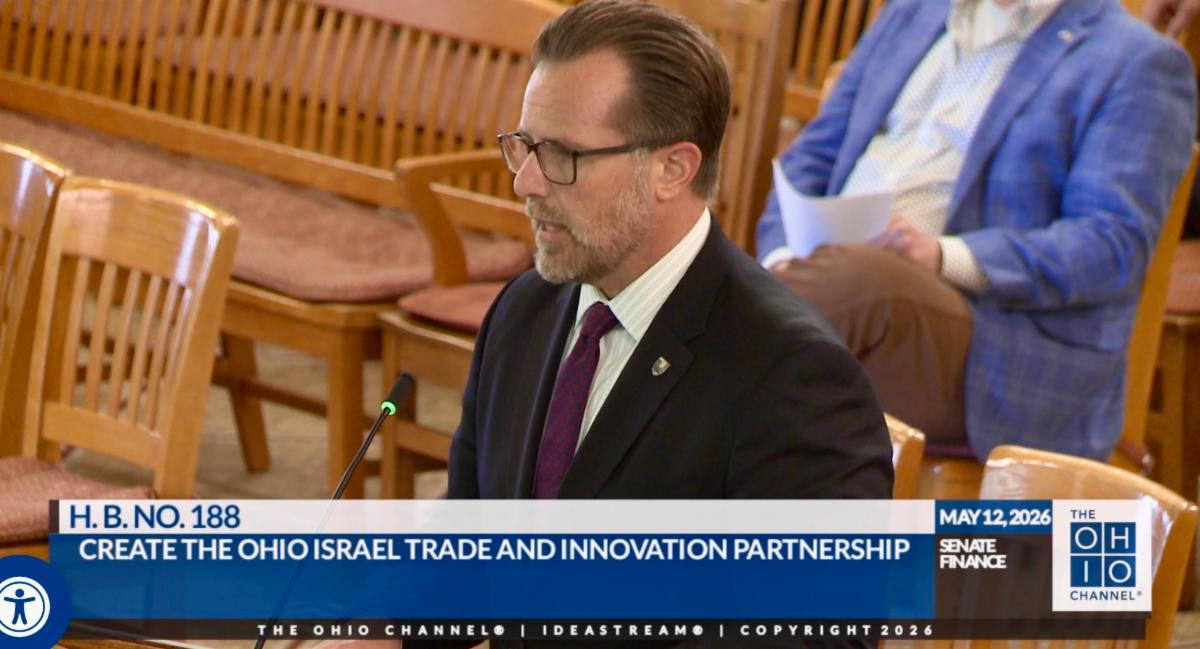
For the second time this General Assembly, the Ohio Chamber provided proponent testimony for House Bill 188. Sponsored by Representatives Hall and Synenberg and passed out of the Ohio House with broad bipartisan support, HB 188 would create the Ohio-Israel Trade and Innovation Partnership, a 14-member commission of legislators, higher education representatives, business community leaders, and Jewish community organizations charged with studying and advancing bilateral trade, investment, academic exchanges, infrastructure, and emerging technology collaboration between Ohio and Israel.


The Ohio-Israel trade relationship is more substantial than many Ohioans may realize. According to data from the Ohio Department of Development, Ohio exported nearly $242 million in manufacturing goods to Israel in 2023 alone. Since 1996, Ohio's cumulative exports to Israel have exceeded $6 billion, and Israel now ranks as Ohio's 26th leading trade partner. Ohio also stands 12th among all states in exports to Israel, a meaningful position for a Midwest manufacturing state competing in a global marketplace.  


On the national stage, that commercial relationship is growing. U.S. goods exports to Israel reached $14.8 billion in 2024, up more than $813 million from the prior year, while U.S. goods imports from Israel totaled $22.2 billion. The U.S.-Israel Free Trade Agreement, the first FTA the United States ever signed and enacted in 1985, has helped fuel a 473% increase in U.S. exports to Israel over that period.


Ohio and Israel have overlapping strengths in manufacturing, technology, agriculture, and clean water innovation that create a natural foundation for deeper commercial ties. The sectors most relevant to Ohio's economy, including advanced manufacturing, aerospace, pharmaceuticals, and industrial machinery, are also among the leading categories in Ohio's existing Israel export portfolio. The partnership would also identify new opportunities across specific industries, emerging technology clusters, and even multilateral trade frameworks involving Israel's relationships with nations in Africa, Asia, Europe, the Gulf, and beyond. As the only country with free trade agreements with both the United States and the European Community, Israel is uniquely positioned to serve as a bridge for Ohio companies seeking broader international market access.


This legislation also arrives at a moment of heightened interstate competition. In April 2026, Indiana Governor Mike Braun announced a $60 million initiative known as "Iron Nation–Indiana", specifically designed to attract Israeli tech companies to establish U.S. headquarters and operations in the Hoosier State. Indiana's move is a reminder that Ohio's historical relationship with Israel, while strong, cannot be taken for granted. HB 188 gives Ohio a formal institutional vehicle to match and exceed that ambition.


HB 188 remains in the Senate Finance Committee where it has now received two hearings and has received testimony from all sides. We remain hopeful the Senate will advance this bill to Governor DeWine’s desk in the coming weeks.

Senate Judiciary Committee Holds Hearings on Multiple Pro-Business Bills

In its first committee meeting since returning from the primary election, the Senate Judiciary Committee held hearings on multiple Ohio Chamber priority bills. House Bill 105 was first up on the committee agenda, and the bill sponsors delivered remarks explaining why their bill brings much-needed transparency to third-party litigation financing. Sponsored by Representatives Meredith Craig and Jim Thomas, House Bill 105 will result in public disclosure of third party financing agreement for the very first time in Ohio. That transparency will help shed light on this sometimes nefarious practice that drives up litigation costs and harms Ohio’s legal climate. 


The committee also received additional proponent testimony on House Bill 126. This legislation tackles a troubling trend of cities and other local governments suing companies who manufacture, sell, or distribute lawful products and alleging these companies are responsible for opaque societal harms like climate change. Aside from our support, the Ohio Council of Retail Merchants, Ohio Manufacturers’ Association, US Chamber of Commerce, and the American Tort Reform Association have all testified as proponents of House Bill 126 because the bill prohibits these types of politically motivated lawsuits. 


A bill reducing the statute of limitations on contracts was on the Judiciary Committee’s agenda as well. Senate Bill 157 continues Ohio’s efforts to bring predictability to a company’s contractual liability by shrinking the tail liability of contract claims from six years to three years. This pro-business reform will benefit Ohio employers by reducing the potential for litigation, since contract-based liability remains even after a company has fulfilled its obligations under an agreement — regardless of how satisfactory performance may have been.


The Ohio Chamber looks forward to continuing our advocacy with committee members to advance all three bills out of the committee before the legislature’s general election recess.

Powered By GrowthZone